
Same Day Crowns: Long‑Term Benefits for Busy Professionals


Quick Answer: same day Crowns deliver comparable Long‑Term durability to Traditional Lab Crowns while cutting appointment time to one visit and improving short‑Term patient satisfaction; for most single Crowns in the front and back of the mouth, Optima Dental recommends CAD/CAM same‑day workflow for Busy Professionals seeking reliable, efficient care.
Why Busy Professionals choose faster crown workflows
Commuting, client meetings, childcare and packed calendars make extra Dental visits costly. You lose billable hours and often push care down the priority list. We see that at Optima Dental, so we moved to a CAD/CAM same‑day crown protocol that preserves Long‑Term outcomes while cutting downtime.
Same day Crowns reduce appointment frequency and missed work compared with conventional Lab Crowns while keeping clinical outcomes on par.
Same day Crowns vs. Traditional Lab Crowns — the direct comparison
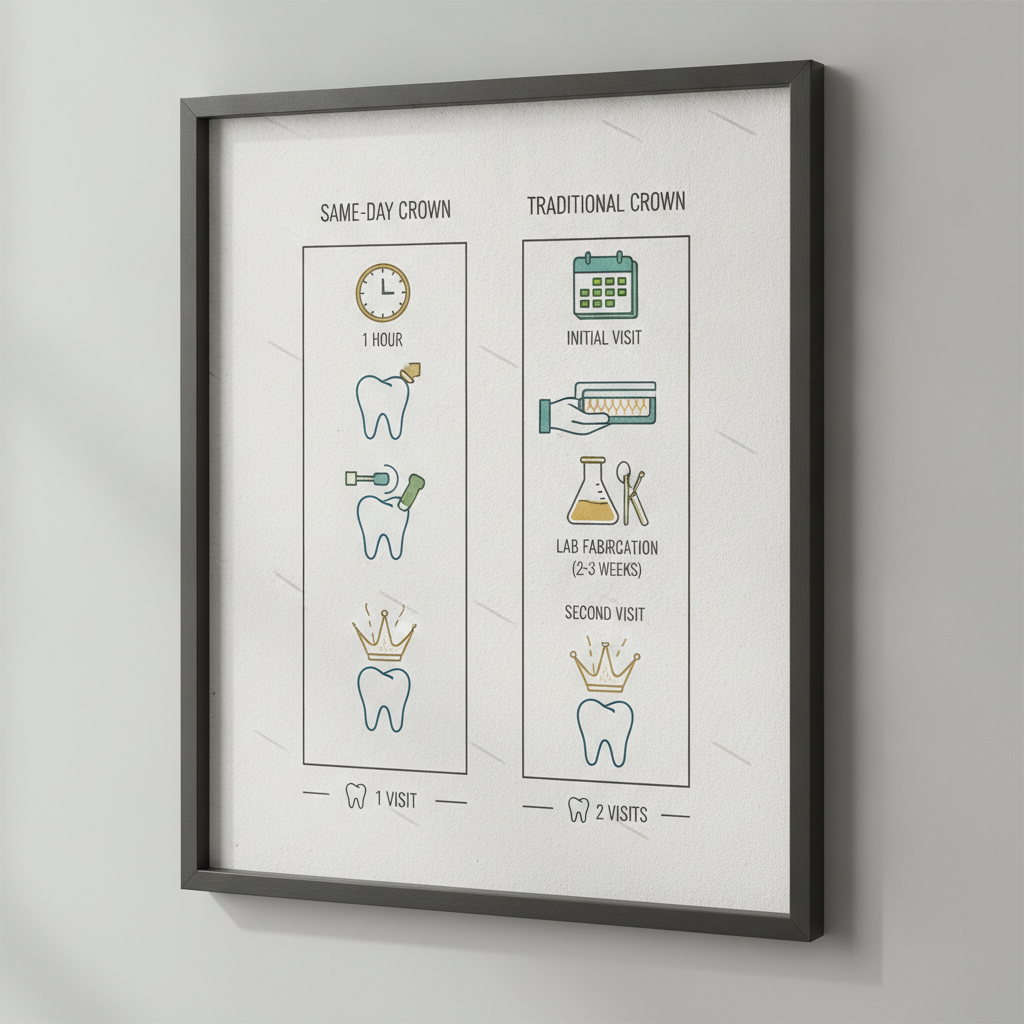
For straightforward single Crowns, chairside CAD/CAM Crowns match Lab Crowns for longevity and appearance, and they beat Lab work on turnaround and convenience.
At a glance — quick stat-backed claims
- Clinical reviews report comparable medium-Term survival for CAD/CAM and Lab-fabricated Crowns; many studies note similar 5‑year survival ranges (see the NCBI: Clinical outcomes of CAD/CAM versus laboratory‑fabricated Crowns).
- Patient satisfaction tends to be higher for single-visit treatments because of fewer appointments and immediate fit, which clinical series summarized in the NCBI review also document.
- The American Dental Association provides practice-level guidance and overview for crown selection and care: American Dental Association: Dental Crowns Overview.
Same day Crowns combine speed with outcomes that align with published clinical data, making them the practical default for many Busy Professionals.
Durability: do same day Crowns last as Long?
Yes. In standard single‑tooth cases, CAD/CAM Crowns show durability on par with Lab Crowns when we control case selection and occlusal adjustment.
Most chairside restorations use high‑strength feldspathic or lithium disilicate ceramic, and we increasingly place monolithic zirconia for posterior loads. Longevity turns on material choice, margin fit, occlusion and cementation. The NCBI review compiles clinical data that show similar failure rates at medium follow‑up when materials and technique match (NCBI clinical review).
Fit and occlusal balance matter more than fabrication route — a well‑adjusted CAD/CAM crown will outlast a poorly fitted Lab crown.
How durable are same day Crowns compared to Lab Crowns?
When placed on a properly prepared tooth with controlled occlusion, same day Crowns perform similarly to Lab Crowns for five years or more in most published series.
Durability depends on three clinic-controlled factors: margin integrity, cementation protocol and occlusal force management. At Optima Dental we document and adjust each of these steps in the chairside workflow to hit those targets. The NCBI review supports equivalence when those variables are controlled (NCBI: Clinical outcomes of CAD/CAM versus laboratory‑fabricated Crowns).
Practical failure modes we watch for include chipping in layered ceramics, adhesive failure with poor isolation, and margin leakage from inadequate capture. We avoid these with strict isolation and scanning standards.
Watch for chipping, isolation breakdown and margin gaps — those failures come from technique, not the CAD/CAM process itself.
Aesthetics: can same day Crowns match Lab-polished looks?
Yes for most single anterior Crowns and many posterior cases. Modern CAD/CAM ceramics and in‑office staining produce highly acceptable results.
Labs still hold an edge for multi‑unit cases that demand custom layering or advanced characterization. For single‑unit lithium disilicate or well-processed zirconia, CAD/CAM gives natural translucency and shade matching that satisfies most patients. We use in‑office shade mapping and clinical photos to reach Lab‑level results.
Same day Crowns meet or exceed aesthetic expectations in the majority of single-unit cases; reserve Lab fabrication for complex cosmetic layering.
Appointment frequency and time costs
Same day Crowns normally take one appointment; Traditional Lab Crowns require at least two and a temporary in between.
Our chairside CAD/CAM workflow compresses preparation, scanning, milling and bonding into one visit of about 90–180 minutes depending on complexity. That saves a full business day for most Professionals. At Optima Dental we’ve optimized the flow so most single Crowns finish within two hours.
Choosing same day Crowns on a workday can save you one full business day compared with a Traditional approach.
Are same day Crowns cost-effective for Busy Professionals?
Often yes. Direct fees vary little between routes, and the patient time savings usually tip the balance.
Traditional Lab Crowns add Lab fees, temporization costs and a second visit. For many patients the value of fewer missed work hours outweighs modest fee differences. We ask patients to weigh out‑of‑pocket time costs when choosing.
If your schedule would force an extra day off for a Lab crown, a same day crown is normally the more cost‑effective option overall.
Clinical decision process: when to choose same day Crowns (Optima Dental protocol)
We follow a short, numbered workflow so clinical risk stays low and outcomes stay predictable.
- Assess case complexity and margins. If margins sit more than 1.5–2.0 mm subgingivally or need extensive tissue management, choose Lab fabrication.
- Evaluate occlusal load. For heavy parafunction or bruxism, prefer monolithic zirconia (CAD/CAM possible) or Lab‑reinforced options and plan a nightguard.
- Decide on esthetic needs. Single anterior Crowns requiring complex layering get prioritized for Lab work; otherwise CAD/CAM lithium disilicate is usually fine.
- Determine number of units. Bridges and multi‑unit splints generally favor Lab workflows.
- Confirm isolation and scanning feasibility. If moisture control and a clear scan field are achievable, proceed chairside.
- Document patient schedule preference. If they cannot return, prioritize same day crown when clinically safe.
The 1.5–2.0 mm subgingival margin guideline reflects real scanning limits and tissue‑capture predictability in everyday chairside practice, and it helps us deliver a predictable fit and finish.
Step-by-step: Optima Dental’s same day crown procedure (exact, operator-level steps)

Below is the chairside workflow we use to deliver a same day crown with predictable Long‑Term outcomes.
- Pre-op documentation: intraoral photos, bite photos, digital charting. Record parafunctional history and medications.
- Anesthesia and preparation: standard crown reduction; allow 1.0–1.5 mm occlusal reduction for lithium disilicate, 1.2–2.0 mm for monolithic zirconia as needed.
- Margin management: keep margins supragingival or shallow subgingival; use a retraction cord when the margin sits near the sulcus (single cord technique preferred).
- Digital scan: use a high‑resolution intraoral scanner; aim for under 3–5 minutes per arch to limit movement artifacts.
- Design: clinician designs the crown in‑software; check occlusion and contacts and target 50–60 micron internal cement space depending on cement.
- Milling: select the block (lithium disilicate for esthetics, monolithic zirconia for load), then mill and sinter/polish per manufacturer guidance. Milling runs 10–20 minutes; fast‑sinter zirconia protocols shorten sintering when appropriate.
- Try‑in and adjustment: verify proximal contacts and occlusion; adjust, stain or glaze as needed; final polish to Ra <0.2 µm to limit antagonist wear.
- Cementation: isolate, use the recommended cement (resin cement for lithium disilicate, resin‑modified glass ionomer or self‑adhesive resin for zirconia as indicated), and follow surface treatment protocols (HF etch for leucite/lithium disilicate, airborne‑particle abrasion and primer for zirconia).
- Post‑op instructions: soft diet for 24–48 hours, occlusion check at 1 week, routine hygiene and nightguard if bruxism is present.
We set internal cement space at 50–60 microns for resin cements to secure predictable seating and retention.
Maintenance tips to maximize crown longevity
Maintenance follows the same principles for both crown types: good hygiene, occlusal checks and a nightguard when indicated.
- Brush twice daily with fluoride toothpaste and floss daily; use interdental brushes for tight contacts.
- Schedule hygiene visits every 3–6 months if you have periodontal concerns; otherwise every six months.
- If you grind or clench, wear a custom nightguard to prevent chipping and reduce cement fatigue.
- Avoid biting hard objects and ice; Crowns tolerate chewing loads but repeated high‑force contacts raise failure risk.
- Report sensitivity or a loose crown immediately — early intervention prevents secondary decay or fracture.
Regular hygiene plus a nightguard when needed extends crown service life by years.
Comparison table — same day Crowns vs Traditional Lab Crowns
| Feature | Same Day Crowns (CAD/CAM) | Traditional Lab Crowns |
|---|---|---|
| Appointment count | One visit (90–180 minutes) | Two or more visits; temporary crown required |
| Time-to-delivery | Same day | 7–14 days typical |
| Durability | Comparable in matched materials and technique | Comparable; Lab can customize for complex cases |
| Aesthetics | High for single-unit; lithium disilicate strong | Superior for multi-layered, bespoke characterizations |
| Cost | Often similar to slightly higher depending on material | Includes Lab fee; total time cost May be higher due to additional visit |
| Best use case | Single Crowns, time-sensitive patients, many posterior restorations | Complex cosmetic cases, multiple-unit bridges, very deep margins |
Patient outcomes, satisfaction, and evidence
Clinical reviews and practice series show high satisfaction with same day Crowns, mainly because patients avoid extra visits and get immediate esthetic results.
The NCBI review comparing CAD/CAM and laboratory‑fabricated Crowns reports similar clinical outcomes when materials and technique match, and it summarizes patient-reported Benefits from reduced treatment time (NCBI clinical review).
Patients who need minimal disruption to work report higher satisfaction with same day Crowns at Optima Dental.
Cost transparency and insurance handling
Insurance codes for Crowns don’t change with fabrication route; coverage depends on plan terms and allowed Lab fees.
We provide pre‑treatment estimates and file claims where possible. Because same day Crowns remove the temporary and the return visit, you May save indirect costs like missed work and childcare — items insurance won’t cover but that matter to total value.
Ask us for an itemized estimate and we’ll walk you through the insurance implications for your plan.
Common mistakes clinicians and patients make — and how we avoid them
Poor case selection, inadequate isolation during bonding, and rushed occlusal adjustments are the most frequent errors.
We prevent those by following the decision workflow above, using isolation aids (rubber dam or retraction), and performing a two‑stage occlusal check during try‑in and after cementation.
Never skip occlusal verification after final glaze; polishing can shift contact points slightly.
How we implement digital dentistry Crowns at Optima Dental
We integrate scanner, design software and in‑office milling with a documented quality checklist to deliver predictable same day Crowns.
Our implementation steps include staff training for the scanner, calibrated milling settings per block type, and a QA sign‑off where two clinicians confirm final fit before cementation. That human check cuts chairside revision rates.
Our documented workflow reduces post‑op adjustments and increases first‑fit success compared with hastily adopted digital setups.
Frequently Asked Questions
How Long do same day Crowns typically last?
Most well-made Crowns, whether same day or Lab-made, last many years; medium-Term clinical data summarized in the NCBI review show similar survival when clinical technique is consistent.
Are same day Crowns covered by insurance?
Insurance covers crown procedures according to plan terms, not fabrication route. We provide pre-treatment estimates and file claims; out-of-pocket costs can differ because of Lab fees and material choices.
Can I get a same day crown if I grind my teeth?
Yes, with caveats: we often use monolithic zirconia and supply a custom nightguard to protect the restoration and opposing teeth.
Do same day Crowns cause more wear on opposing teeth?
High-quality polishing and correct material selection minimize antagonist wear; we target a final surface roughness that balances durability with low-wear contact.
If you want the speed and predictability of same day Crowns, learn more about our same‑day Crowns at Optima Dental or schedule your crown consultation and we’ll outline your options on a single call.