
Invisalign vs Braces for Adults: Which Choice Wins for Busy South Bay Professionals


Invisalign vs Braces: Quick Comparison for Professionals
Invisalign vs Braces adults can feel like a head‑to‑head showdown, especially for Busy South Bay Professionals juggling meetings, deadlines, and family time. The answer isn’t a one‑size fit: each option offers distinct benefits and trade‑offs. Understanding how treatment length, aesthetics, diet restrictions, and appointment frequency stack up helps you choose the right path for your smile.
Why the Choice Matters for Your Schedule
When your calendar is packed, the orthodontic route you pick can ripple through every meeting, travel plan, and weekend. Traditional Braces stay on the teeth, so you can eat almost anything, but they need regular check‑ins. Invisalign aligners sit in a plastic tray, are removable, and usually require fewer office visits. That difference translates into real time saved.
Treatment Length: Fast‑Track or Steady Progress?
On average, Invisalign takes 12–18 months for adults with mild to moderate misalignment, while Braces can finish in 18–24 months. The key difference is the treatment cadence: Braces often need appointments every 4–6 weeks; Invisalign patients usually visit the office every 6–8 weeks, except for the first two aligners, which are swapped after two weeks each.
Aesthetic Impact: Discretion vs Visibility
Clear aligners are virtually invisible, so you can walk into a boardroom without anyone noticing. Braces, especially the newer ceramic or lingual variants, reduce the metallic glare but still stand out to the eye. If your profession values a polished look at all times, Invisalign gives you that edge.
Diet Restrictions: Eat Without Limits or Plan Ahead?
With Invisalign, you remove the aligners before eating or drinking anything that isn’t water. That means you can enjoy coffee, wine, or a protein shake during lunch. Braces don’t impose diet restrictions; you simply avoid hard, sticky foods that might damage the brackets. For those who love spontaneous treats, Invisalign offers more freedom.
Appointment Frequency: How Often Will You See the Dentist?
Braces generally require visits every 4–6 weeks for tightening and adjustments. Invisalign, on the other hand, sees a patient every 6–8 weeks, unless you need a quick check‑in. That reduction in appointments is a major time saver for a professional who travels or has unpredictable hours.
Retention and Stability: Which Keeps the Results?
After Braces, a removable retainer is usually prescribed, and the brackets provide a built‑in retention surface. Invisalign patients often need a clear retainer or a custom-made appliance to keep the teeth in place. Both options work well when followed, but Braces offer a slightly more solid initial stability for complex corrections.
Decision‑Making Flowchart: Pick the Right Path Fast
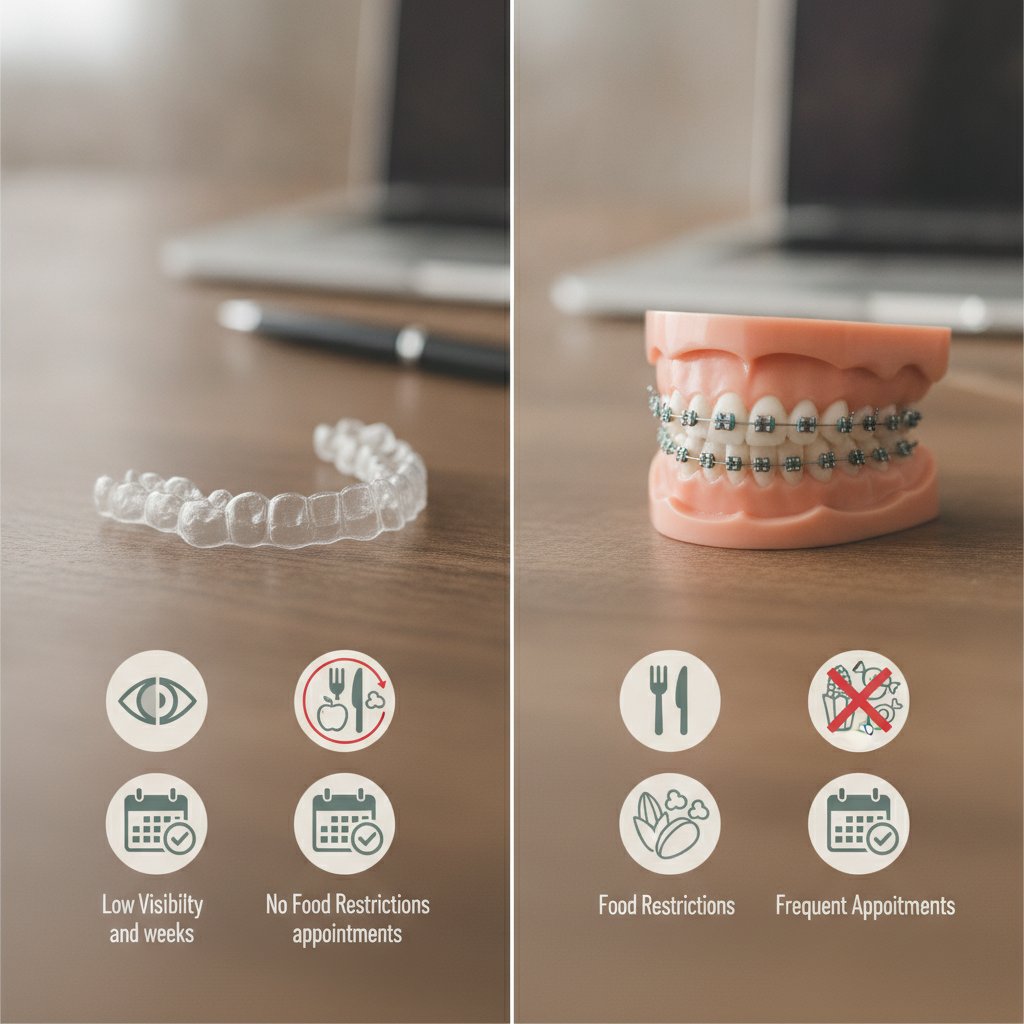
Follow this quick flowchart to decide between Invisalign and Traditional Braces. The numbered steps include specific thresholds that a practitioner uses in the clinic.
- Assess Overjet and Overbite – Measure with a caliper. If overjet exceeds 5 mm or overbite is greater than 3 mm, Braces are often recommended.
- Measure Crowding – Use a digital scanner. Mild crowding (≤4 mm) can be handled by Invisalign; moderate (4–7 mm) May be borderline.
- Check for Rotations or Root Torque – If rotations exceed 20° or root torque issues exist, Braces provide better torque control.
- Evaluate Root Resorption Risk – If prior history of root resorption is present, Braces are safer.
- Lifestyle and Diet Flexibility – Prefer Invisalign if you want to eat freely without removing appliances during work.
- Time Availability for Visits – Choose Invisalign if you can only manage visits every 6–8 weeks.
- Cost Considerations – Braces May be cheaper upfront, but Invisalign often includes a digital plan that can reduce unexpected adjustments.
After you run through these steps, match your results to the table below to see which option lines up with your priorities.
Invisalign vs Braces: Feature Comparison
| Feature | Invisalign | Traditional Braces |
|---|---|---|
| Treatment Duration | 12–18 months (mild–moderate cases) | 18–24 months (mild–severe cases) |
| Aesthetic Visibility | Almost invisible | Visible; ceramic options reduce glare |
| Diet Restrictions | Remove before eating any non‑water beverage | None – brackets stay on teeth |
| Visit Frequency | Every 6–8 weeks | Every 4–6 weeks |
| Control of Tooth Rotation | Limited for severe rotations | Excellent torque control |
| Retention Strategy | Clear retainer or custom appliance | Removable retainer + built‑in bracket retention |
| Typical Cost Range | $4,000–$6,000 | $5,000–$8,000 |
Professional Orthodontic Options at Optima Dental
Our team in San Jose offers Invisalign treatment at Optima Dental that starts with a comprehensive digital assessment. We use 3‑D imaging to build a precise treatment plan and monitor progress every visit. If your case needs the extra torque a metal bracket can provide, we’ll discuss the best Braces strategy right away.
Beyond orthodontics, Optima Dental’s full range of Dental services offered by Optima Dental includes implants, crowns, and cosmetic procedures that can enhance the final smile. Our goal is to make every step smooth and aligned with your professional life.
Ready to explore your options? Schedule your orthodontic consultation today and let our experienced team map out a plan that fits your calendar and your smile goals.
Frequently Asked Questions
What’s the first step if I’m interested in Invisalign?
Book an initial consultation. We’ll take digital scans, discuss your goals, and create a treatment plan that fits your lifestyle.
Do Braces work better for severe misalignment?
Yes. Braces provide stronger torque control and are preferred when significant rotations or root torque issues are present.
Can I wear Invisalign aligners while traveling?
Absolutely. Just remove them before meals and bring a spare pair in your carry‑on.
How often do I need to visit the office for Invisalign?
Typically every 6–8 weeks, though the first two aligners are swapped after two weeks each to keep the treatment on schedule.
What happens after I finish Braces?
You’ll receive a retainer to maintain the new alignment. Follow the dentist’s instructions for wear time and care.
Clinical Considerations: When Braces Are Medically Preferred
Beyond lifestyle preferences, certain clinical conditions strongly favor fixed appliances (Braces). These include:
- Severe skeletal discrepancies that May eventually need orthognathic surgery or preparatory Dental alignment.
- Large rotational corrections where root control is critical—for rotations over ~20° fixed wire mechanics provide predictable force vectors.
- Cases with compromised periodontal support where controlled, lighter forces from fixed systems can be delivered by an experienced orthodontist with close monitoring.
- Patients with a history of root resorption or low bone density where treatment planning often requires the precision of bracket/archwire systems.
In short: if your X‑rays show complex root movements are necessary, Braces are often the recommended medical option.
Cost Breakdown and Insurance: What Professionals Should Know
Cost is a leading factor. Here’s a Practical breakdown tailored for Professionals who want to plan expenses and use employer benefits efficiently:
- Base fees: Invisalign typically ranges $4,000–$6,000; metal Braces $5,000–$7,000; ceramic or lingual Braces can cost more (up to $8,000+).
- Insurance: Many Dental plans cover a portion of orthodontic costs for adults—check your annual maximum and lifetime orthodontic benefit cap. For many employer plans, adult orthodontia falls under the same lifetime maximum as pediatric care, so early verification is key.
- FSA/HSA: If you have a Flexible Spending Account (FSA) or Health Savings Account (HSA), orthodontic treatment is an eligible expense. For Busy Professionals, setting aside pre-tax dollars can reduce real cost by 20–30% depending on your tax bracket.
- Financing: Most practices (including Optima Dental) offer 0% financing or monthly payment plans ranging 12–36 months. This allows Professionals to manage cash flow without delaying treatment.
Tip: Ask your orthodontist for a full treatment estimate that includes finishing touches (refinements, retainers, follow‑ups) so you aren’t surprised by end‑of‑treatment costs.
Statistics and Evidence: What the Research Shows
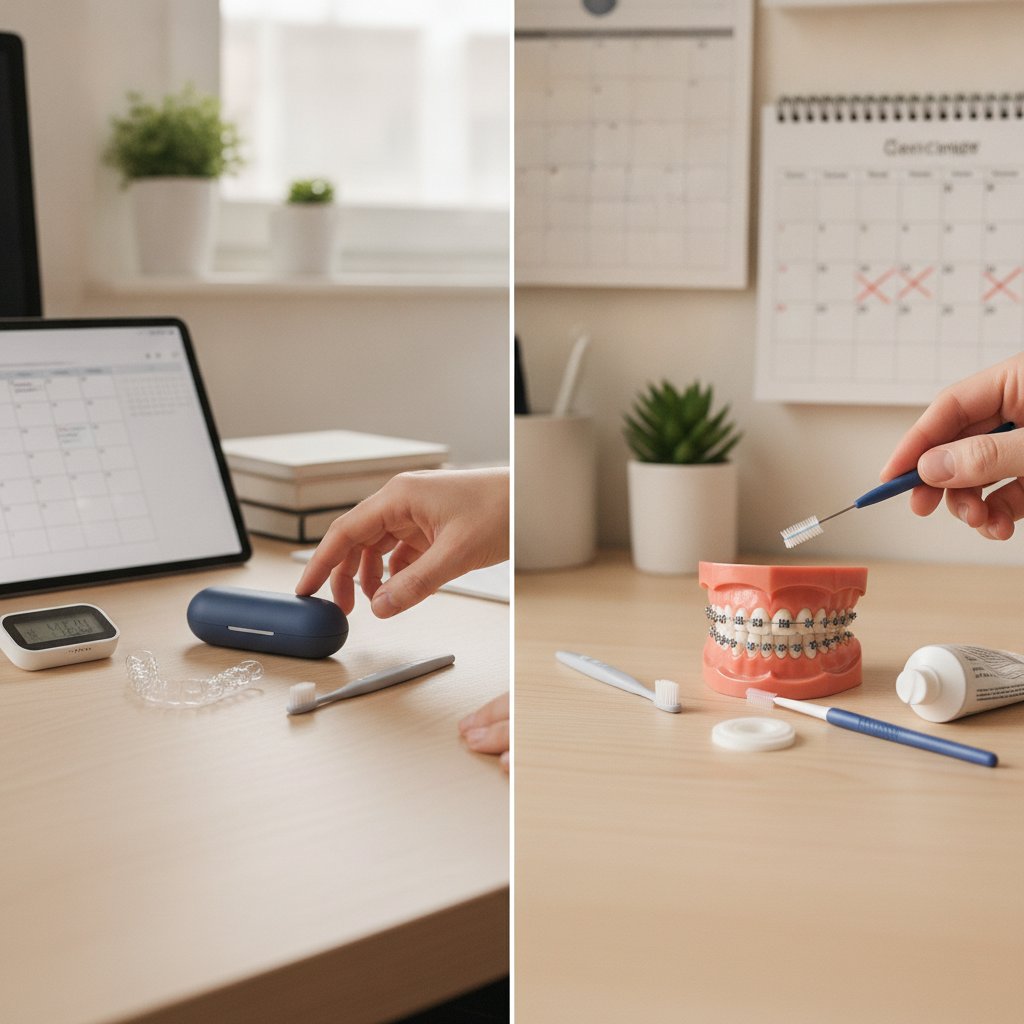
Clinical literature and practice audits provide useful guidance for adult patients:
- Effectiveness: Peer-reviewed studies indicate Invisalign and other clear-aligner systems reliably treat mild to moderate malocclusions with success rates often reported in the 80–95% range when patients are compliant.
- Patient satisfaction: Surveys across mixed adult cohorts commonly report higher satisfaction for aesthetics and comfort with aligners; reported satisfaction rates often exceed 85% for aligner patients vs. slightly lower for Traditional Braces.
- Treatment time: For comparable malocclusions, aligner therapy tends to be as fast or slightly faster for mild-to-moderate cases; complex cases typically require longer treatment and May favor fixed appliances.
- Compliance impact: The single biggest predictor of aligner success is wear time. Data from manufacturer compliance studies and clinical audits show that wearing aligners 20–22 hours daily produces optimal outcomes; missing wear time correlates with extended treatment and reduced predictability.
These figures are reported across clinical audits, journals, and manufacturer studies. Discuss the evidence specific to your case during your consultation—some clinical scenarios still have clearer outcomes with Braces.
Patient Experience: Day‑to‑Day Scenarios for South Bay Professionals
Below are three routine‑based scenarios that illustrate how treatment choice affects a Busy professional’s day.
Morning Client Presentation (Public Speaking)
Invisalign: You can remove aligners briefly for a 30–45 minute presentation to avoid any potential lisps and replace them immediately afterwards. Most executives prefer the near‑invisibility during client interactions.
Braces: No removal is necessary, but be mindful of potential glare on camera or when smiling broadly in photos. Ceramic brackets are less reflective under studio lights.
Business Lunch with a New Client
Invisalign: Remove your trays, enjoy the meal, and brush or rinse before re‑inserting. Aligners can be discreetly stored in a case without interrupting conversation.
Braces: Choose menu items that are soft and non‑sticky. Cutting foods into smaller pieces helps avoid bracket damage and maintains a professional dining pace.
Travel and Last‑Minute Meetings
Invisalign: Pack an aligner case, a travel toothbrush, and a spare tray. If you have frequent red‑eye flights, aligners make it easy to maintain hygiene during long travel days.
Braces: A travel Dental kit with orthodontic wax and floss threaders is essential. Emergency visits are rarer but sometimes necessary if a bracket loosens in transit.
Real‑World Case Studies from South Bay Professionals
Below are three anonymized case studies from our practice that show how decisions are made and outcomes achieved.
Case 1: “Elaine,” Startup CTO — Chose Invisalign
- Age/Profession: 38, CTO, frequent investor meetings and pitch decks.
- Problem: Mild crowding (3–4 mm), slight midline shift, primarily cosmetic concern.
- Decision: Invisalign due to aesthetics and travel schedule.
- Treatment: 14 months, 12 aligners, visits every 6–8 weeks. Minor refinements at month 10.
- Outcome: Alignment achieved, high patient satisfaction, retained full professional schedule without interruption.
Case 2: “Mark,” Trial Attorney — Chose Ceramic Braces
- Age/Profession: 45, trial attorney, rarely wants appliances noticed in close courtroom interactions.
- Problem: Moderate rotations and root torque requirements, overbite 3.5 mm.
- Decision: Ceramic Braces for better torque control with reduced visibility.
- Treatment: 20 months, monthly appointments to adjust wires and monitor root movement.
- Outcome: Excellent occlusion and function; used clear retainers post‑treatment for maintenance.
Case 3: “Priya,” Marketing Director — Invisalign with Interproximal Reduction
- Age/Profession: 32, marketing director with frequent media appearances.
- Problem: Mild crowding plus cosmetic symmetry concerns.
- Decision: Invisalign with IPR (interproximal reduction) to create space without extractions.
- Treatment: 12 months; strong compliance (22 hours/day) led to on‑schedule completion.
- Outcome: Smooth transition, minimal speech interference, and faster recovery from refinements.
Practical Tips for Compliance and Comfort
- Set reminders on your phone to swap aligners and track wear hours.
- Carry a small Dental kit with a toothbrush, floss, and aligner case for meals out.
- Use orthodontic wax for brackets that irritate the lip or cheek in the first week.
- Stay hydrated—aligners can dry the mouth slightly; drinking water helps maintain comfort and oral health.
Expanded Frequently Asked Questions
Will Invisalign affect my speech?
Some patients notice a slight lisp for the first few days as the tongue adapts to the aligner. Most speech normalizes within a week. If public speaking is frequent, plan to wear a new aligner for a few days before a major presentation so your speech has time to settle.
What if I forget to wear my aligners for a few days?
Missing wear time delays progress and can require wearing a previous aligner again or extending overall treatment. If you miss several days, contact the office—your provider May advise stepping back to the previous tray for a short period or adjusting the plan.
Are there any restrictions for smokers?
Smoking discolors aligners and increases oral health risks during orthodontic treatment. While it doesn’t automatically preclude Invisalign, quitting or cutting back improves outcomes and reduces staining on clear retainers or aligners.
Can I combine Braces and cosmetic work like veneers or crowns?
Yes. Orthodontic treatment often precedes restorations to place teeth in optimal positions. If you have existing crowns or implants, your orthodontist will coordinate with your restorative dentist to ensure attachments and treatment mechanics are compatible.
What should I do in an orthodontic emergency (e.g., a broken bracket)?
Contact your orthodontist promptly. For Braces, orthodontic wax can temporarily cover sharp ends. For aligners, save the damaged tray and bring it to your appointment—often we’ll advise moving to the next tray early or repairing the current setup.
Does age matter for orthodontic treatment?
Adults of virtually any age can benefit from orthodontic treatment as long as oral health (gum health, bone support) is adequate. Treatment mechanics differ slightly from adolescents, but success is routinely achieved in middle‑aged patients and beyond.
How do I clean my Invisalign trays?
Rinse aligners with water after removal, brush gently with a soft toothbrush (no toothpaste for long‑term use, as it can be abrasive), and soak occasionally in a cleaning solution recommended by your provider.
Will orthodontic work increase tooth sensitivity?
Temporary sensitivity after adjustments or when switching trays can happen. It typically subsides in a few days. Over‑the‑counter analgesics and soft foods help manage discomfort. Persistent or severe sensitivity should be evaluated by your dentist.
Further reading
- Industry background on search engine optimization — authoritative reference reading.