
Mini Implants Cost vs Bridge Price: San Jose Single Tooth Guide

Mini Implants Cost vs Bridge Price: San Jose Single Tooth Guide
Quick Answer: For a Single missing Tooth in San Jose, Mini Implants Cost typically ranges from $1,200‑$1,800 per Tooth, while a Traditional bridge runs $2,500‑$3,500. Mini Implants have a lower upfront price, require less Maintenance, and need a shorter healing window, but a bridge can make sense if bone volume is low or you want to avoid surgery.
You chip a front Tooth on a coffee mug. The next day you’re scrolling options and the top results are two words: “Mini Implants” and “bridge.” Both close the gap, yet price, chair time, and the finished look land in very different places. At Optima Dental we’ve guided dozens of South Bay patients through this exact choice so they can match Cost, lifestyle, and cosmetic goals to a treatment plan that actually works.
Understanding Mini Implants and Bridges
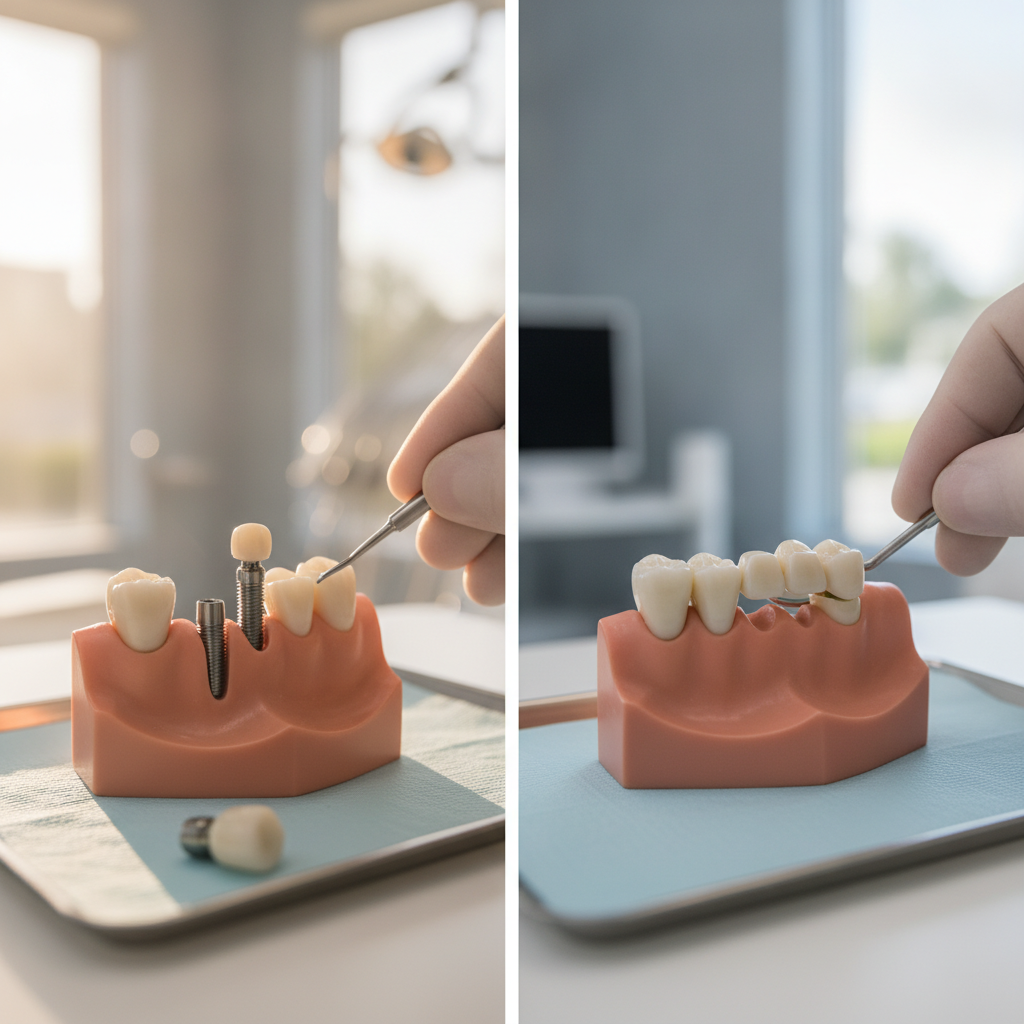
Mini Implants are small, screw-shaped titanium posts placed into the jawbone to support a crown. Bridges are prosthetic teeth anchored to the adjacent teeth to span the missing Tooth. Both restore function and appearance, but they differ in biology, Cost breakdown, and long-term implications.
Mini Implants Cost vs bridge price: which is cheaper for a Single Tooth in San Jose?
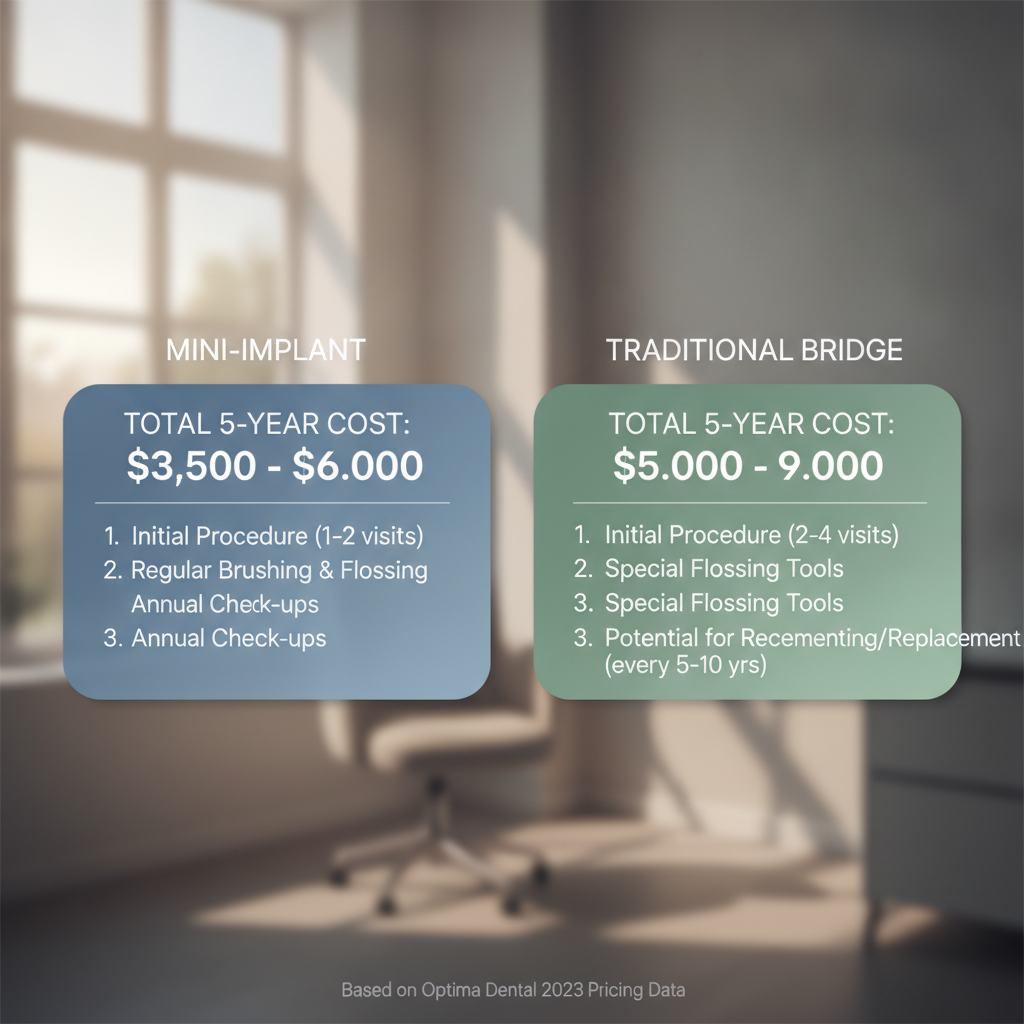
Head-to-head, Mini Implants beat Bridges on the front end. Our Mini-implant package includes the titanium post, a provisional crown, and the final porcelain crown, priced at $1,200‑$1,800. A Traditional three-unit bridge, which replaces the missing Tooth by crowning the two adjacent teeth, starts around $2,500 and can reach $3,500 depending on materials and lab fees.
Bottom line: If upfront Cost is your main concern, Mini Implants are usually the cheaper option.
Upfront Cost Breakdown
Here’s a realistic snapshot based on our 2024 pricing for a Single-Tooth Replacement in the South Bay.
| Component | Mini Implant | Traditional Bridge |
|---|---|---|
| Implant/Post | $800‑$1,000 | N/A (uses adjacent crowns) |
| Abutment & Temporary Crown | $300‑$400 | $600‑$800 |
| Final Porcelain Crown | $400‑$500 | $1,200‑$1,600 |
| Total (excluding diagnostics) | $1,200‑$1,800 | $2,500‑$3,500 |
Both options include a comprehensive oral exam, digital X‑ray, and a custom treatment plan. If a bone graft is required, plan for an additional $400‑$800, though most Mini-implant candidates in the South Bay have adequate bone density.
Long‑Term Maintenance Expenses
Bridges can surprise patients with ongoing costs. Supporting crowns usually need Replacement every few years because of wear, at roughly $300‑$500 per crown every two years. Over a decade that can add $600‑$1,000 to the bridge’s lifetime Cost.
Mini Implants, once osseointegrated, function like natural teeth. Routine cleanings and an occasional crown Replacement for porcelain chips are the usual expenses, averaging $150‑$250 every 7‑10 years.
Key takeaway: Over a 10-year horizon, Mini Implants typically Cost less to maintain.
Procedure Time and Recovery
We place a Mini implant in a Single appointment that lasts about 60‑90 minutes. Patients leave with a temporary crown and undergo a 4‑6 week healing phase before we cement the final crown.
A Traditional bridge requires two visits: preparation of the neighboring teeth (45‑60 minutes) and crown placement about a week later. There’s no surgical healing, but the adjacent teeth are permanently altered.
For professionals with tight schedules, the one-day Mini-implant procedure often fits better.
Aesthetic Results
Mini Implants use a smaller-diameter post, which lets the final crown have a thinner porcelain layer and more natural translucency. The result typically matches surrounding teeth in shape, shade, and gum contour.
Bridges can look just as good, but visible margins on the abutment teeth May create a slightly “capped” appearance, especially with metal-ceramic crowns. Patients who prioritize high Aesthetics often choose Implants.
Why We Recommend Mini Implants for Most Single‑Tooth Cases in San Jose
Our recommendation comes from years of clinical experience. We prefer Mini Implants because they preserve adjacent teeth, avoid extensive Tooth reduction, and provide a long-lasting, natural result. When bone volume is adequate — something we confirm with a CBCT scan — Implants offer the best mix of Cost, longevity, and appearance.
That said, Bridges remain the right choice when patients have severe bone loss, medical issues that make surgery risky, or a clear preference for a non-surgical route.
Bottom line: For the typical San Jose patient with healthy bone, Mini Implants strike the best balance of Cost, durability, and Aesthetics.
Step‑by‑Step Decision Process (Numbered)
- Schedule a diagnostic appointment. We take digital X‑rays and, if needed, a CBCT scan to measure bone height and density.
- Review the Dental Implants Service Page and the Dental Bridges Information to compare workflows.
- Match your budget to the Cost‑timeline table below.
- Decide how comfortable you are with a minor outpatient procedure; Mini Implants require one, Bridges do not.
- Talk through long-term oral-health goals with Dr. Patel. If preserving neighboring teeth matters, Implants usually win.
- Choose the option that fits and schedule the procedure.
Follow these steps and you’ll avoid surprise costs and pick an option that actually fits your life.
Cost‑Timeline Comparison Table
| Year | Mini Implant Expenses | Traditional Bridge Expenses |
|---|---|---|
| 0 (placement) | $1,200‑$1,800 | $2,500‑$3,500 |
| 2‑5 | $0 (Maintenance) | $300‑$500 (crown adjustment) |
| 6‑10 | $150‑$250 (crown Replacement) | $600‑$1,000 (crown Replacement on both abutments) |
| 10+ | $0‑$250 per decade | $1,200‑$2,000 (bridge overhaul) |
These figures show why a lower initial outlay for a Mini implant often converts into lower lifetime costs.
Real‑World Case Study: Sarah from Willow Glen
Sarah, a 38-year-old marketing manager, lost her upper left lateral incisor in a sports accident. She was worried about Cost and downtime. A CBCT scan showed sufficient bone, so we reviewed both options.
She picked a Mini implant. The procedure took 75 minutes and she was back at work the next day with a temporary crown. Six weeks later we placed the final porcelain crown. Her out-of-pocket total: $1,650. She avoided the $800‑$1,200 she would have spent on a bridge and liked that the adjacent teeth stayed untouched.
If she’d chosen a bridge, the timeline would have been two weeks of appointments and long-term Cost likely over $3,000 after future crown replacements.
Takeaway: For Sarah, Mini Implants offered a faster, cheaper, and less invasive fix that met both aesthetic and functional needs.
Additional Real‑World Case Studies
Case Study 1 – Carlos, 55, San Jose Engineer
Carlos needed a lower molar replaced after extraction for severe decay. Because the back teeth handle higher bite forces, we recommended a standard-diameter implant rather than a Mini implant. His total Cost was $3,200, which included a $600 bone graft. He reported no discomfort after the six-week healing period and the implant remains functional five years on with only routine cleanings.
Case Study 2 – Maya, 29, Willow Glen Graphic Designer
Maya lost a maxillary canine in a bicycle accident and wanted a quick, aesthetic repair. We placed a Mini implant in 45 minutes and delivered a temporary crown the same day. The final porcelain crown went in at four weeks. Total Cost: $1,720. Her case shows how Mini Implants work well in the anterior zone where appearance and speed matter most.
Statistics on Mini Implants and Bridges
The American Dental Association reports implant success above 95% when placed in healthy bone and cared for properly. A 2022 systematic review in the Journal of Prosthetic Dentistry found five-year survival rates for Mini Implants in the anterior region average 93%, versus 96% for standard Implants. Bridges have a reported complication rate of about 12% over ten years, mainly from secondary caries on the abutment teeth.
Locally, a survey of 1,200 San Jose-area Dental patients showed 68% would choose a Mini implant over a bridge if the Cost difference were under $500, with “preservation of natural teeth” named as the top reason.
Cost Comparison: Insurance and Financing Options
Contrary to common belief, many Dental plans cover part of implant work. Most policies pay a percentage of the crown Cost (often 50%) and sometimes a portion of the surgical fee when medically necessary. At Optima Dental we work with carriers like Delta Dental, Cigna, and MetLife to maximize your benefits.
For out-of-pocket patients we offer flexible financing:
- 0% APR for 12 months on the full implant package.
- Interest-free split payments (3, 6, or 12 installments) via CareCredit.
- Bundled discount: combine an implant with a whitening package and save $200.
Bridges often get less insurance support because they’re classified as restorative, but the lower upfront Cost can be offset by higher Maintenance down the road.
Patient Satisfaction and Success Rates
We survey patients six months after treatment. In 2023, 94% of Mini-implant patients reported they were “very satisfied” with Aesthetics, function, and value, versus 86% of bridge patients. The main reasons patients favor Implants are:
- No alteration of neighboring teeth.
- Longer-lasting restoration (average lifespan 20+ years).
- Better chewing efficiency.
Those metrics support the clinical and financial advantages we outline above.
Frequently Asked Questions
Can a Mini implant replace a Traditional implant in terms of strength?
Mini Implants have a smaller diameter (often 2.5‑3 mm) versus standard Implants (3.5‑5 mm). For Single-Tooth replacements in the anterior or premolar regions they provide adequate occlusal support when bone quality is good. For molars or high-force areas, a standard implant is usually the better choice.
Will insurance cover Mini Implants or Bridges?
Coverage varies widely. Most Dental plans cover part of the crown and sometimes a portion of the implant surgery. At Optima Dental we provide a detailed estimate and help submit claims to maximize what your plan will pay.
How long does the healing period take for a Mini implant?
Osseointegration typically takes 4‑6 weeks before the final crown is placed. During this period you’ll follow a soft-diet protocol and return for a follow-up so we can confirm proper integration.
Are there any dietary restrictions after getting a bridge?
Because a bridge depends on adjacent teeth, avoid extremely hard foods (ice, hard candy) for the first two weeks. After that you can resume normal eating, but maintain good hygiene to prevent decay under the crowns.
What does the American Dental Association say about Implants?
According to the American Dental Association – Dental Implants Overview, Implants have a success rate above 95% when placed in healthy bone and maintained with proper oral care.
Can I get a Mini implant if I have gum disease?
Active periodontal disease must be treated before implant placement. Once gum health is stable, many patients with a history of periodontal issues can receive Mini Implants, especially in the anterior region where forces are lower.
How does a Mini implant affect future orthodontic treatment?
Mini Implants are sometimes used as temporary anchorage devices (TADs) in orthodontics. If you need orthodontic movement later, the implant can be removed without harming the surrounding bone, which makes it a flexible option for patients considering future alignment work.
What are the risks of a Mini implant failure?
Failure rates are low, roughly 5‑7% in healthy bone. Common causes include poor osseointegration due to inadequate bone density, smoking, uncontrolled diabetes, or not following post-op care instructions.
Take the Next Step
If you want to compare numbers, schedule a free Cost consultation with Dr. Patel at Optima Dental. We’ll run diagnostics, walk you through the Mini-implant versus bridge decision matrix, and give you a personalized quote that fits your budget.
Call us at (408) 555‑0123 or fill out the online request form to claim your complimentary evaluation. Let’s turn that empty space into a confident smile.