
All-On-4 San Jose: Which Implant Fits South Bay Residents Best?


All-on-4 San Jose gives you a faster, lower‑bone‑volume route to a full arch, while Traditional Dental Implants San Jose are the better choice when you want tooth‑by‑tooth restoration and the greatest long‑term flexibility. Base your decision on jaw anatomy, timeline, budget, and whether you need immediate function; the sections below walk you through exact decision steps and South Bay cost ranges.
Why South Bay patients are choosing implant solutions now: All-on-4 San Jose Explained
Patients here want reliable chewing, fewer denture frustrations, and treatment that Fits a busy life. We see two main approaches: All‑On‑Four and Traditional multi‑implant restorations. Each has clear tradeoffs in candidacy, surgery, recovery, maintenance, and cost.
All‑On‑Four reduces grafting needs and speeds return to function; Traditional Implants give more restorative flexibility.
What is All‑On‑Four and how does it differ from Traditional Dental Implants?

All‑On‑Four secures an entire prosthesis to Four (sometimes more) Implants in an arch, using angled posterior Implants to avoid bone grafts. Traditional Implants replace each missing tooth or use several Implants per arch to support bridges. For a concise technical primer see the All‑On‑Four overview (Wikipedia).
Practical difference in the chair
With All‑On‑Four we treat the arch as a single prosthetic unit, which often lets us deliver an immediate provisional. With Traditional Implants we plan each crown or bridge independently and May delay final restorations to let bone and soft tissue mature.
Who is a candidate for All‑On‑Four vs Traditional Implants?
Candidacy hinges on bone volume, medical status, and restorative goals. Below are the concrete criteria we use at Optima Dental to choose a path.
If you need a full arch and have limited posterior bone, All‑On‑Four is usually the faster, simpler Option; if you want individual tooth replacement and have good bone, choose Traditional Implants.
Optima Dental’s candidacy checklist (practical, operator-tested)
- Medical clearance: Patients with uncontrolled diabetes (HbA1c >8.0%), recent jaw radiation, or active IV bisphosphonate therapy need physician clearance before implant surgery.
- Tobacco: Quit before surgery and during healing; heavy smokers (more than 10 cigarettes/day) face higher failure risk.
- Bone volume and quality: We use cone‑beam CT to measure vertical height and cross‑sectional width. For All‑On‑Four, minimal posterior grafting is acceptable when the anterior mandible provides adequate bone. For Traditional Implants we look for roughly 6–8 mm width and 10–12 mm height per site or plan grafting.
- Immediate loading threshold: For same‑day provisionals we target insertion torque ≥35 Ncm and confirm primary stability. If torque is lower we stage the restoration.
- Hygiene and follow‑up: Candidates must commit to periodic hygiene visits and home care; full‑arch prostheses need specific maintenance visits every 3–6 months initially.
These are the practical rules we apply during consultation and CBCT review — we measure, we don’t guess.
How do surgical timelines compare?
All‑On‑Four compresses stages — implant placement and a provisional prosthesis often happen the same day. Traditional Implants are typically staged, with months between placement and final crowns, especially if grafting is required.
All‑On‑Four gets you out of dentures faster; Traditional Implants usually require a longer healing window but let you rebuild tissues site by site.
Detailed timeline breakdown
| Phase | All‑On‑Four | Traditional Implants (per tooth) |
|---|---|---|
| Consult & diagnostics | CBCT, intraoral scan, treatment planning — 1–2 visits | Same as All‑On‑Four |
| Surgery | Placement of Four Implants; same‑day provisional often possible | Placement of 1+ Implants; May add grafting; provisional timeline varies |
| Healing | 3–6 months for osseointegration under provisional bridge | 3–6 months (longer if grafting was required) |
| Final restoration | Conversion to definitive prosthesis in 3–6 months | Individual crowns/bridges placed after osseointegration |
Reference: For general procedural expectations see the Mayo Clinic – Dental Implant Surgery.
What does recovery look like for each Option?
All‑On‑Four can feel more intense at first because you’re having a full arch treated, but you get immediate stability. Traditional Implants tend to produce less soreness per site, but multiple staged surgeries add up in total recovery time.
Short term: All‑On‑Four is more intensive but shorter overall recovery; long term: both approaches require the same hygiene commitment.
We prescribe antibiotics selectively, anti‑inflammatories, and cold‑pack care. Soft diet for about two weeks, then progress. For All‑On‑Four we limit hard food on the provisional for at least three months. With single Implants, if the implant is left unloaded we May allow localized function sooner.
How do long‑term maintenance and complications compare?
Both options are predictable with proper maintenance. Full‑arch bridges more commonly show prosthetic screw loosening and wear. Traditional crowns have biological risks at each implant site. The patterns differ; the need for regular care does not.
Maintenance matters more than the system — regular hygiene and timely repairs keep Implants functional for many years.
Common mistakes we fix: skipping maintenance visits, using hard picks that damage prosthetic parts, and not using night guards when bruxism is present. We train South Bay patients on home care for each prosthetic design.
How much does each Option cost in the South Bay?
Pricing structures differ: All‑On‑Four is per arch; Traditional Implants are per tooth. Local factors — lab materials, number of visits, grafting, and digital workflow — change the final quote.
In South Bay markets, plan for either per‑tooth Implants or a single‑arch All‑On‑Four budget; exact pricing requires a CBCT and a treatment plan.
Approximate South Bay market ranges (for planning only):
- Traditional Dental Implants San Jose: roughly $3,000–$6,000 per tooth for implant + abutment + crown. This covers common materials and standard lab fees.
- All‑On‑Four (full arch): often ranges $18,000–$30,000 per arch depending on prosthetic materials and whether zirconia or acrylic‑over‑titanium is chosen.
These are market approximations to set expectations. For a tailored quote schedule a digital consult so we can produce a definitive estimate.
Does digital implant dentistry change the equation?
Yes. Digital workflows cut chair time, improve predictability, and yield better-fitting provisionals and finals.
Our digital workflow shortens planning, improves surgical accuracy, and helps deliver Same‑Day CAD/CAM Crowns when appropriate.
How we use digital tools at Optima Dental (concrete steps):
- CBCT scan (3D) to map bone and anatomy; we import DICOM into planning software.
- Intraoral scan to capture soft tissue and occlusion; we align it to the CBCT to create a prosthetically driven plan.
- Design a surgical guide with planned implant angulation and length; mill or 3D‑print the guide for guided surgery.
- Place Implants using the guide; intraoperative checks include insertion torque testing and radiographic confirmation.
- Design and mill a provisional prosthesis when immediate loading criteria are met, or have the lab fabricate an immediate temporary within 24–48 hours.
We link this stream to our Same‑Day CAD/CAM Crowns program for single‑tooth cases and to expedited provisional fabrication for full‑arch cases.
Which Option should you choose? A clear, practical recommendation
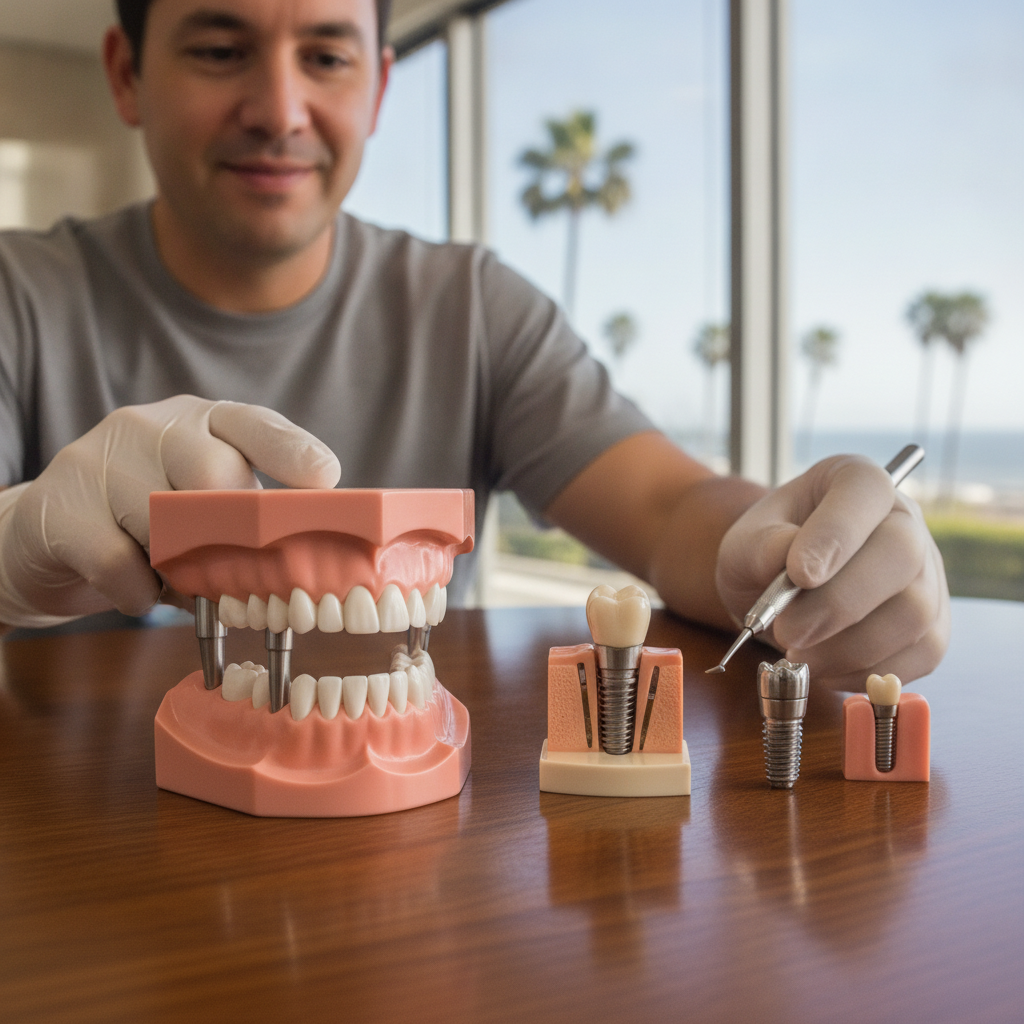
For most South Bay patients who need a full arch quickly and have limited posterior bone, we recommend All‑On‑Four. If you prioritize individual tooth replacement, or you have adequate bone and want the flexibility of separate crowns, Traditional Implants make more sense.
We recommend All‑On‑Four for full‑arch immediacy and minimal grafting; choose Traditional Implants when you want per‑tooth restorations and the most prosthetic flexibility.
Six‑step decision process we use at Optima Dental (exact, repeatable)
Follow these steps; we use them in every consultation.
- Collect diagnostics: CBCT + intraoral scan + medical history (done in one visit where possible).
- Assess bone: measure anterior and posterior heights/widths on CBCT. If posterior height <8 mm and grafting is undesired, mark candidate for All‑On‑Four.
- Evaluate systemic health: If HbA1c >8.0% or active IV bisphosphonate use exists, pause and coordinate with the patient’s physician.
- Decide on immediate loading: test insertion torque at surgery. If torque ≥35 Ncm and stability measures are acceptable, proceed with immediate provisional; otherwise stage the restoration.
- Choose prosthetic material: pick zirconia for durability and esthetics in heavy‑bite patients; choose acrylic over titanium for lower initial cost or retrievability needs.
- Plan maintenance schedule: set recalls at 3 months during the first year, then every 6 months once stable. Document prosthetic components for future servicing.
These are exact thresholds and staging decisions we apply in real time.
What mistakes do South Bay patients commonly make — and what we do instead
Patients often pick a single online price or choose solely on cost, then get surprised by grafting, lab fees, or extra visits. We stop that by delivering a CBCT‑backed, itemized estimate before any surgery.
Don’t choose based only on a headline price — insist on a CBCT‑based plan and a written estimate that lists grafts, provisionals, and maintenance visits.
- Mistake: Buying the cheapest implant placement. What we do: Provide an itemized plan showing implant brand, restorative materials, and lab steps.
- Mistake: Skipping hygiene. What we do: Set explicit recall intervals and teach prosthetic‑specific home care.
- Mistake: Accepting a one‑size‑Fits‑All prosthesis. What we do: Offer material choices and explain trade‑offs in weight, retrievability, and esthetics.
How we price and present treatment at Optima Dental (transparent approach)
We provide an itemized, digital treatment plan after CBCT. It lists every component — Implants, abutments, provisional, final prosthesis, lab fees, and follow‑ups — so you can compare options apples‑to‑apples.
Ask for an itemized CBCT‑based estimate; at Optima Dental we only proceed when you understand the plan and costs.
See our general practice implant overview for more details: Dental Implant Services at Optima Dental.
Two common patient scenarios, with recommended paths
Scenario 1 — Full upper arch, prior denture, limited posterior bone
Recommendation: All‑On‑Four with immediate provisional. We avoid sinus lifts, use tilted posterior Implants, and deliver a provisional same day when insertion torque criteria are met.
Scenario 2 — Single failing tooth, high esthetic demand
Recommendation: Traditional implant with a custom abutment and a Same‑Day CAD/CAM Crown when possible, followed by a ceramic crown once soft tissue matures.
Are Implants safe? What does the Dental community say?
Implant therapy has excellent long‑term success when patients follow care guidelines and systemic risks are managed. See professional guidance from the American Dental Association – Dental Implants.
Implants are a well‑established treatment when planned and maintained correctly; authoritative guidance is available from the ADA and clinical resources like the Mayo Clinic.
Frequently Asked Questions
How long do All‑On‑Four Implants last?
They can last decades with proper care. The implant fixtures often remain stable long term, though prosthetic parts May need repair or replacement over time.
Can I get same‑day teeth with Traditional Implants?
Yes, in select cases. If a single implant reaches primary stability (we target ≥35 Ncm), we can place a provisional crown same day and finish with a definitive crown after healing. We support this through our Same‑Day CAD/CAM Crowns workflow.
Will insurance cover All‑On‑Four?
Insurance varies. Many plans cover part of implant care; some treat full‑arch prosthetics as prosthodontic benefits. We provide estimates and help submit claims when possible.
Which is better for chewing hard foods?
Both perform well if restored correctly. For heavy grinders we recommend strong materials (monolithic zirconia) and a night guard to protect the restoration.
How do I schedule a free consultation?
Call our San Jose office or use online booking to arrange a free implant consultation. We’ll take a CBCT if needed and provide a written treatment plan with options and pricing.
Next steps — what to bring to your consultation
Bring recent Dental x‑rays, a list of medications, and your questions about timelines, budgets, and esthetics. If you don’t have a CBCT we’ll order one during the visit.
A CBCT and intraoral scan are the only reliable way to compare All‑On‑Four versus Traditional Implants for your specific anatomy.
Closing recommendation
See an implant dentist with a digital workflow for a CBCT‑based plan before committing to treatment. For full‑arch immediacy and to avoid grafting, All‑On‑Four San Jose often Fits best. For targeted, tooth‑by‑tooth restoration and maximum prosthetic flexibility, Traditional Dental Implants San Jose remain the standard.
Ready to decide? Schedule a free implant consultation with Optima Dental to get a measured CBCT plan, an itemized estimate, and a clinician’s recommendation tailored to your jaw, timeline, and budget.
Dental Implant Services at Optima Dental • Same‑Day CAD/CAM Crowns